Usage‑Based Billing for SaaS: How to Get It Right for AI‑Native Products

Usage‑based billing has moved from a niche pricing experiment to a core business model for SaaS - and it’s especially critical for AI‑native products where costs and value are both highly variable. Yet many teams still struggle with where to start, how to structure it, and how to avoid creating a billing system they’ll regret in 12 months.
This guide walks through what usage‑based billing is, why it matters for AI and agentic products, and how to design a usage‑based or consumption‑based pricing model that actually works in production.
What is usage‑based billing for SaaS?
Usage‑based billing (sometimes called consumption‑based pricing or pay‑as‑you‑go pricing) is a model where customers pay based on how much they use a product, not how many seats they buy or which static plan they choose.
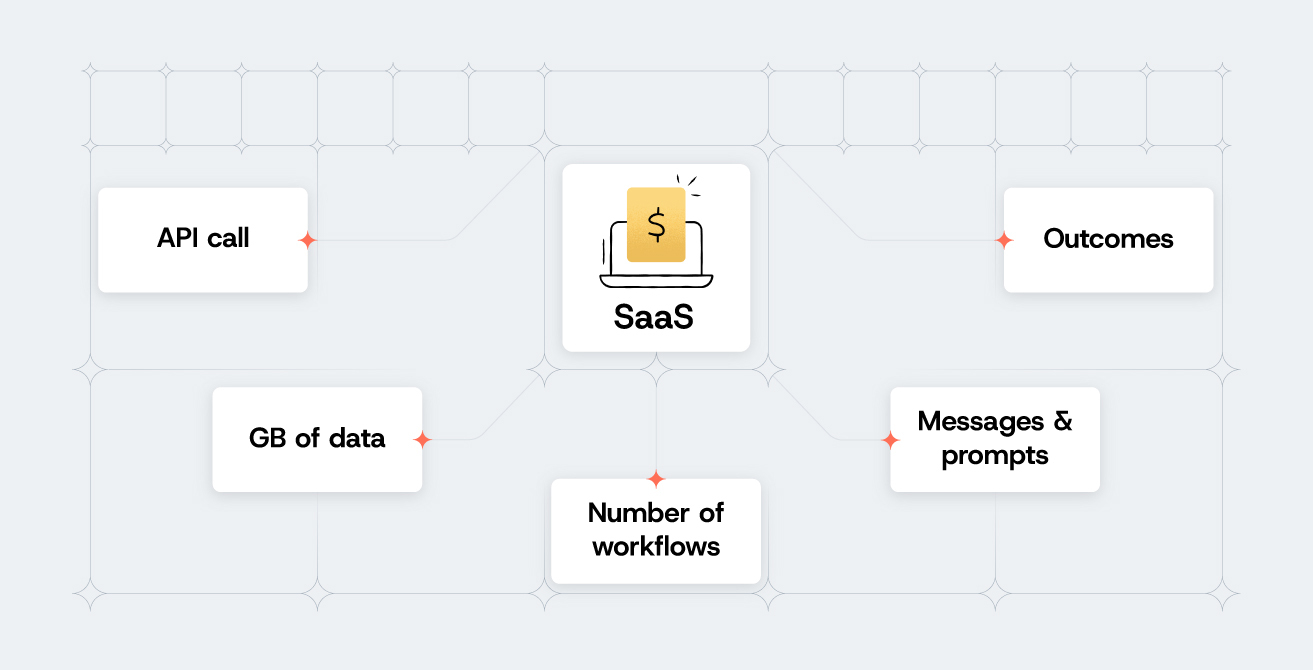
Instead of charging a flat monthly subscription, you charge per:
- API call
- GB of data processed or stored
- Number of workflows or tasks completed
- Messages, prompts, or tokens consumed
- Outcomes (for example, tickets resolved or invoices reconciled)
For AI‑native products, this model aligns naturally with both underlying costs (compute, model calls, storage) and customer value (what the agent actually does).
Why usage‑based pricing makes sense for AI and agentic products
Traditional SaaS pricing was built for a world where humans log into software and click around. You charge per user or per seat; revenue scales with headcount.
AI breaks that assumption:
- One agent can quietly replace the work of dozens of seats
- Costs are tied to compute and external tools, not logins
- Value is delivered through outcomes and automation, not just access
That creates three problems if you stay with seat‑based pricing:
- Misaligned value
Heavy users and high‑value workflows are under‑monetised; light users feel over‑charged. - Poor cost control
Your cost base is usage‑driven (tokens, calls, workflows), but your revenue is not. Margins become hard to predict. - Limited experimentation
Every time you want to try a new pricing model, you end up hard‑coding logic into your app or billing scripts.
Usage‑based or consumption‑based pricing lets you tie revenue directly to how much value an AI product delivers—without forcing customers into artificial seat limits.
Key usage‑based billing models for SaaS (examples and when to use them)
Most successful AI and SaaS companies don’t use a single pure model; they combine several. Here are the main patterns.
1. Pure usage‑based pricing (pay‑as‑you‑go)
Customers pay only for what they consume - for example, per API call, per 1,000 tokens, or per workflow run. This model makes it easy for teams to start small, experiment, and expand naturally as usage (and value) grows.
Best for:
- Developer‑first products and APIs
- Early‑stage products where you need low friction to adopt
- Highly elastic workloads (spiky usage)
Watch out for:
- Revenue volatility if customers’ usage is seasonal or episodic
- Sticker shock for customers if bills vary too much month to month
2. Usage‑based tiers
You define usage bands (for example, up to 100,000 events, up to 1 million, etc.) and price each band. This gives customers clearer “plans” to choose from while still letting revenue scale with adoption.
Best for:
- Mid‑market SaaS with finance teams that want predictability
- Products where you can segment based on typical usage patterns
Watch out for:
- Complexity when customers want to move between tiers mid‑cycle
- Edge cases like pro‑rating, upgrades, and back‑dating
3. Hybrid subscription + usage
A fixed base fee plus a variable usage component—for example, $X per month + $Y per 1,000 workflows. The base fee anchors the commercial relationship, while the usage component captures upside as customers grow.
Best for:
- Products with ongoing value even at low usage (support, SLAs, onboarding)
- Enterprise customers who need a baseline commitment
Watch out for:
- Over‑complicated plans that customers have trouble understanding
- Misaligned expectations if the “included” usage is too high or too low
4. Outcome‑based or value‑based pricing
You charge based on outcomes - cases resolved, dollars recovered, hours saved rather than internal metrics like API calls or tokens. This aligns what you earn with the business value your product delivers.
Best for:
- Agentic products that replace meaningful human work (support, finance, ops)
- Verticals where the value per outcome is clear (collections, fraud, sales)
Watch out for:
- Instrumentation complexity (you must track outcomes reliably)
- Negotiations with enterprise customers about what counts as an outcome
Usage‑based vs subscription pricing for AI‑native SaaS
For AI‑native SaaS, traditional seat‑based subscriptions are easy to forecast but often break the link between costs, usage, and value, while usage‑based billing stays tightly aligned with how agents consume, compute and deliver outcomes. The right choice is usually not either‑or but a blend - using subscriptions for baseline access and support, and usage‑based pricing on top to capture the upside from heavy workloads and automation.
How to design and implement a usage‑based pricing model for Saas (step-by-step)
Moving to usage‑based billing isn’t just a pricing decision; it’s a systems decision. To make it work, you need to think about metering, pricing logic, and billing operations from day one.
1. Start from the customer’s mental model
Ask: When my customer looks at an invoice, what makes intuitive sense?
Good metrics usually:
- Map closely to how they experience value (for example, tasks completed, workflows automated)
- Are easy for finance to forecast (they can connect them to their own KPIs)
- Are hard to game (avoid metrics customers can easily manipulate without gaining value)
Usage metrics that customers struggle to understand - like raw token counts - can still work, but they may need to be wrapped in higher‑level concepts (for example, “assistant sessions” or “automated cases”).
2. Separate metering from pricing
One common mistake is baking pricing logic directly into product code.
Instead:
- Treat metering as a separate layer: track every relevant event (calls, tokens, actions, outcomes) as neutral data
- Treat pricing as a configurable layer: apply rates and rules to those events to generate invoices
This separation gives you two advantages:
- You can experiment with new pricing models without redeploying your application
- You keep a clean audit trail from event → rated usage → invoice, which finance will eventually demand
3. Plan for edge cases up front
Usage‑based billing introduces operational scenarios you can’t ignore:
- Customers upgrading mid‑cycle
- Credits and refunds for outages
- Spikes and anomalies (for example, bug‑induced traffic)
- Free trial periods and promotional credits
You don’t have to solve every edge case before launch, but you should decide:
- How you’ll handle them in principle
- Whether your billing infrastructure can support those rules without manual work
4. Make finance and RevOps first‑class stakeholders
Usage‑based billing is as much a finance initiative as a product one.
Involve them early to answer:
- What margin do we need to protect at different usage levels?
- What reporting will we need (cohorts, unit economics, customer‑level profitability)?
- How will this flow into accounting and revenue recognition?
If your billing stack can’t produce the reports they need, you’ll eventually end up rebuilding it.
The hidden infrastructure challenges behind usage‑based billing
From a distance, usage‑based billing looks like a pricing problem. Up close, it becomes an infrastructure problem.
To make it work at scale, you need systems that can:
- Meter high‑volume events reliably (especially for agents and background tasks)
- Apply complex pricing rules without latency or failure
- Handle tax, refunds, and disputes across multiple geographies
- Integrate with your existing PSPs (cards, bank payments, wallets)
- Provide clear, auditable reporting to finance and customers
Trying to bolt this onto a subscription‑only billing stack or to rebuild it from scratch every time you change your model -quickly turns into technical debt.
That’s why more AI‑native teams are looking at usage‑based billing infrastructure, not just dashboards or scripts.
Where Paygentic fits
Paygentic is built for AI‑native and agentic products that need to turn variable usage into clean, predictable revenue.
With Paygentic you can:
- Meter any usage or outcome event from your product in real time
- Apply usage‑based, consumption‑based, or hybrid pricing without touching core product code
- Enforce cost coverage for agent execution with pre‑funded budgets
- Integrate with your existing payment stack rather than ripping it out
- Give finance the auditability and margin visibility they need
If you’re considering usage‑based billing for an AI or agentic product and you want to avoid rebuilding billing every time your pricing evolves. Paygentic gives you infrastructure designed for that reality.
→ Book a 30‑minute session to map out your usage‑based billing model.